Summer 2026 Fellows Spotlight
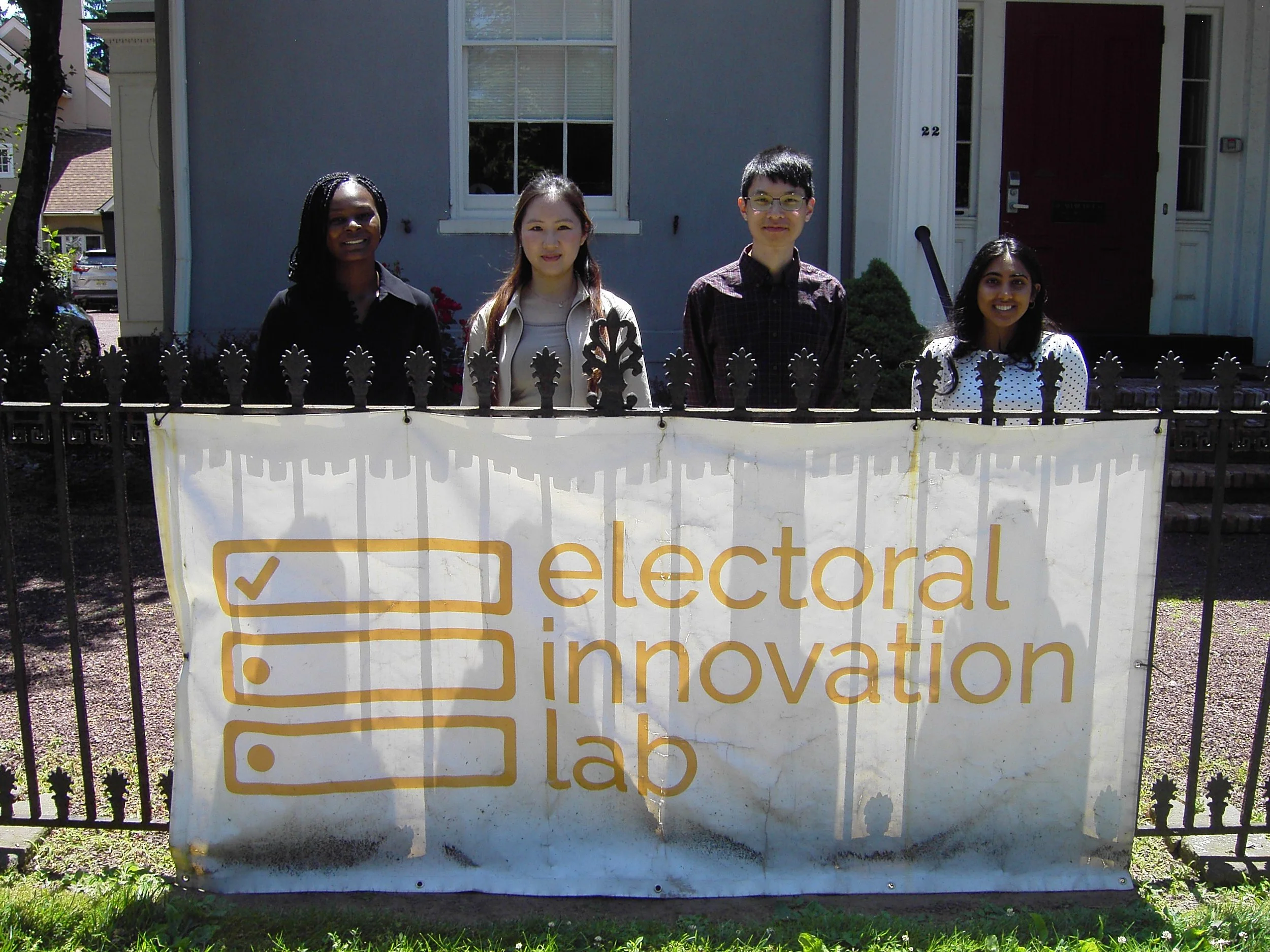
This summer, we had the privilege of hosting four summer fellows, who focused on both civic technology and policy research. Aside from supporting the development of our two upcoming civic tools Vote Maximizer and the 50-State Playbook, the summer fellows completed independent research projects.
Ochuwa Garuba
Ochuwa is a Policy Research Fellow at the Electoral Innovation Lab. At EIL, she completed an independent project that combined a quantitative and qualitative analysis to understand the future implications of the John R. Lewis Voter Empowerment Act of New Jersey, passed in July 2026. California was the first state in the US to enact its own Voting Rights Act in 2002. Ochuwa conducted a predictive analysis based on municipal descriptive representation data available in California to forecast how the new law may impact local descriptive representation outcomes in New Jersey, the newest state to enact its own Voting Rights Act.

Shawn Lu
Shawn’s independent project examined whether Asian Americans are more likely than other racial and ethnic groups to remain unaffiliated with a political party and how primary election rules shape minority political representation. Because closed primary systems require party affiliation, Asian Americans, who may be less likely to register with a political party due to immigrant experiences and political socialization, may be disproportionately excluded from participation, especially in states such as New Jersey where primary elections are closed.

Mili Shah
Mili conducted her independent project on the impact of prison gerrymandering on voters. Focusing on the top three states with the largest incarcerated populations (Montana, Mississippi, and Louisiana), she simulated the electoral and partisan consequences of counting voting ineligible incarcerated populations where they are incarcerated rather than at their home addresses. She finds that while there is no clear partisan effect, prison gerrymandering inhibits fair representation within these states by affecting the distribution of voter power.

Elaine Zhao
Elaine focused on the implications of the Fair Representation Act (FRA), which proposes that all states adopt multi-member districts and ranked choice voting for congressional elections. Her research evaluates how effectively the Act improves proportional representation and increases competition at the state level. Using mathematical methods and computer simulations, she finds that in state senate elections, FRA meaningfully improves the proportionality of partisan representation. While the number of competitive seats declines under the FRA, voters become more influential with the improved per-district competitiveness.

To learn more about our work and opportunities to collaborate with us, visit our projects and publications page.